
EXECUTIVE PRESENCE
The Expert Guide to Deliver Eloquently & Succeed in a Viva Voce Exam
The complete guide to achieving eloquence and poise for your Viva Voce Exam or Public Defence.

This guide will give you insights into key considerations to take into account before your viva voce preparations, so you know what to focus on next. If you're about to take your first viva, are struggling to pass it, or want to prepare with increased efficiency to achieve speaking success when the day arrives, this article will get you started.
Key Benefits of Using Speaking Strategies in Your Viva Voce Exam as a Medical Specialist or PhD Candidate
- Entering your oral exam hurdle with tactics will benefit not only your performance on the day, but your well being in the lead up.
- Designing a performance anxiety management protocol can increase your chance of success by preparing your mind, thoughts as well as body for peak performance.
- The viva voce/ public defence tends to increase speaking stress, even in communicators who are normally calm and at ease on stage or in public speaking activities. Planning and training the desired speaking style will assist you to deliver eloquently, thus increasing your success likelihood.
- When faced with a viva voce that you're struggling to clear, don't despair. While the exam intends to appraise your professional competency, your results are more likely the outcome of how effectively you engage the panel, gain influence, build rapport and signal legitimacy- measures that benefit from tactical charisma training.
Content
- What is a Viva Voce Exam?
- What a viva voce aims to do
- Types of Viva Voces/ Public Defences
- Closed-door Viva Voce (Private Defence)
- Hybrid Viva Voce (Public Defence)
- Ritualised Viva Voce
- Performance + Public Defence
- When are Viva Voces used?
- PhD completion
- Proficiency tests
- Does entry to the Bar involve a Viva Voce exam?
- Specialist registration for MDs
- Are OSCEs the same as Viva Voce Exams?
- Let's get your Speaking ready for your Viva Voce
- Most Viva Voce exams induce nerves and performance pressure
- A Viva Voce is a Performance
- 7 Communication Domains to Help your Speaking Performance
- Preparing to deliver the best CONTENT in the Viva
- Content tips for Doctoral (PhD) Candidates
- Content tips for Medical Fellow Candidates
- Incorporating Performance Tactics to Optimise your COMPOSURE & DELIVERY in the Viva
- Logical delivery skills
- Captivating storytelling
- Speech cadence
- Confident voice tone
- Your visual impression
What is a Viva Voce Exam?
If you're a PhD candidate, aspiring surgeon or physician, you've no doubt grappled with pending concerns about an upcoming Viva voce exam.
Written exams to test competence can seem the norm these days; however, it wasn't always that way. Since medieval times, scholars were examined in public, orally and in Latin, with the notion of a written exam only emerging in the late 18th century as the standard. As student numbers increased with the Industrial Revolution, it became more challenging to examine every student in the traditional viva voce format and as such in recent years vivas have been designated to the elite scholastic pathways, the seal of the doctoral defence for most European Continent and British PhDs and most famously in medicine, the final most crucial rite before Fellowship.
In recent times, Viva voce exams have remained the mainstay for niche, high-level final qualifications. Their use will likely increase, particularly as a robust way to protect academic integrity in student assessment in the face of rogue use of AI (Cassidy, 2024).
Viva Voce: "with living voice."
- Medieval Latin
Viva voce exams are high-stakes assessments designed to measure whether candidates have the skills, knowledge, and competence. Typically used for medicine, the Phd defence, and other forms of scholastic proficiency testing.
What a Viva Voce aims to do
Viva voces aspire to test your competency and skill as an expert in your discipline in a conversational, dynamic format, particularly when under pressure, and predominantly to measure factors such as your autonomous rationales, decision-making skills, in-depth learning and critical thinking in real time.
Types of Viva voce exams
Even though research indicates that the experience hardly differs among candidates according to the type of viva voce taken (most are anxious and feel the performance pressure), knowing the kind of viva voce exam you must take will adjust the practice criteria and training system recommended to benefit your success.
Closed- door Viva Voce (Private Defence)
A closed-door viva voce is more commonly used for doctoral candidates in the UK (Stephenson, 2024), with some adoption noteworthy in Malaysia, Australia and New Zealand as well. Widely used as a standard for PhD completion, but also the likely format if you’re striving to gain medical specialist registration, or to certify as an architect, since the process will involve only you and the examiner/interview panel behind closed doors.
Hybrid Viva Voce (Public Defence)
The public defence is an established way of assessing PhD success wherein candidates are required to deliver a public presentation to an audience that synthesises their thesis, followed by an open debate, most often with the examining committee, but in some rare cases involving open questioning by the audience as well. This mode of viva voce is the established norm for most of Europe as well as North American universities. Interestingly, this approach of examination is novel and rarely used, rather than mandatory for most Australian PhDs.
Ritualised Viva Voce
The Ritual Viva voce constitutes the protocol of a viva with the understanding that the thesis and doctoral award are already approved and passed. Situated as a ceremonial formality, this format is the most likely process if you’re completing a PhD in Scandinavia. Typically conducted in academic regalia, with the university mace present, a ritualised viva voce is more pomp and circumstance, given successful completion, justifying the final ceremonial Viva voce.
Performance + Public Defence
In the European university system, there exists another rare alternative by which performing artistes have the opportunity to complete a PhD Thesis, with a live performance hurdle (often up to 6 concerts) as well as a public defence. I was subject to this format of public defence, whereby I had to both perform some technically virtuosic arias and music related to my thesis topic before then segueing into active public defence to the panel with a public audience present. A preferable assessment format for musicians and performers seeking a doctorate in Europe, at large, this adds an overt performance hurdle to showcase virtuosic mastery of the artist's genre; the recipient receives a single doctorate comprised of a professional specialty in their genre of performance coupled with a scientific specialty. Now that's robust! And terrifying. Can you imagine singing as well as defending your thesis in one live session?
Guide for Medical Fellowship Candidates: How to Survive & Succeed Speaking in Your Viva Voce Exam
When are Viva Voces Used?
Although most famed for their role of awarding PhD completion, Viva voce exam formats are also likely critical hurdles for MD specialisation pathways.
PhD Completion
As mentioned, Vivas are most commonly used for the defence of a PhD thesis or as a formality for PhD completion.
Proficiency Tests
In some cases, proficiency tests (e.g. tests of English speaking skills) may constitute some portion that takes the form of a viva voce (as in the case of IELTS), more often than not using a closed-door process.
Does Entry to the Bar Involve a Viva Voce Exam?
Interestingly, despite the heavy professional reliance on communication competency and extensive knowledge, barristers are called to the bar based on successfully meeting curriculum requirements, character tests, and written and/or practical assessment metrics.
Specialist Registration for MDs
Surgeons
Australasia
- The Fellowship Exam - FEX (e.g. with the Royal Australasian College of Surgeons (RACS), enabling the award of Fellowship of RACS (FRACS) as well as specialist registration with AHPRA;
North America
- The Certifying Exam with the American Board of Surgery, enabling the award of Diplomate of the American Board of Surgery, in which the candidate becomes Board Certified in Surgery.
Physicians
Australasia
- The Fellowship Exam- FEX (e.g. with the Royal Australasian College of Physicians (RACP), enabling the award of Fellowship of RACP (FRACP) as well as specialist registration with AHPRA;
North America
- The Certifying Exam with the American Board of Internal Medicine, enabling the award of Diplomate of the American Board of Internal Medicine, in which the candidate becomes Board Certified in Internal Medicine
A note on other regions
European Union
- In the European Union, most medical specialist registration is governed at the national level (e.g., the Facharztprüfung contains an oral component for specialist registration in Germany, with similar viva voce hurdles in other countries like Spain, France, Italy and more).
Asia
- Likewise, throughout Asia, medical specialist registration is governed at the national level (e.g., the Specialist Board Examinations of South Korea or Japan, the National Medical Licensing Examination in China). In these systems, the viva voce component is a critical measure necessary for specialist registration.
Latin America
- Across Latin America, the standard process upon completion of residency involves a detailed viva voce as well (e.g., in Brazil, the Titulo de Especialista administered by the Brazilian Medical Association incorporates a viva voce component, similarly in Colombia, ACEMCOL awards specialisations with a viva voce to evaluate clinical judgement, ethics, and communication).
Are OSCEs the same as Viva Voce Exams?
No, although both involve an oral component, OSCEs and viva voce exams are different.
OSCEs: timed clinical exams with multiple stations usually built around matriculating checklists that clinical professionals are required to show proficiency in while administering care or showing clinical decisions with actors or a simulator. [definition]
Viva Voces: in contrast, in academia, viva voces seek to establish the defence of a thesis, ideas, or research and involve open-ended questions posed by the examiners/ panel to establish knowledge-defence proficiency. Vivas for medical fellowship entry typically seek to determine your character, ethical scope and legitimacy of entry to the given specialisation and may comprise more behavioural, open questions.
Let's get your Speaking Ready for your Viva Voce
Now that you’ve hopefully established your required viva voce rite of passage, whether for PhD or Board certification, it’s time to consider how to diligently and efficiently prepare for your best outcome.
Most Viva Voce exams induce nerves and performance pressure, no matter the format, objective or specialty.
Despite the mixed approaches to completing a viva voce exam, research by Lantsoght (2021) reveals that defence format variations do not alter the experience of the PhD candidate or aspiring medical specialist.
At Cadenza, we frequently meet clients who are apprehensive about their PhD defence. It’s no surprise with the pressure that arises in realising that the successful culmination of years and countless hours of dedicated study, research, innovation and writing hangs in the balance of either a public or private defence (unless if you’re in Scandinavia where it is a mere PhD formality, not assessment metric).
And then, if you’re an aspiring surgeon or physician, you’re likely very aware of the pressure your colleagues face or maybe, like many of our clients, you’re taking the viva for the 3rd or 4th time. In this case, be assured that there are noteworthy approaches to adjusting your behavioural performance that can make a difference to how you position yourself in front of the panel of examiners to showcase your proficiency, clinical integrity and advanced competency expected to achieve the public guarantee of your rite of passage.
A Viva Voce is a Performance
Whether it’s your first or fifth attempt, a viva voce can be approached with empowering strategies suited to performing, rather than anxious thought intrusions.
Your viva performance comprises two elements:
Content: what you say
Delivery: how you present it
Both elements work symbiotically and play a vital role in determining the impression you give.
These two elements are no different in performance, let’s consider a top tier violinist and their performance on-stage.
Content: Brahm’s Violin concerto in D Major, Op. 77
Delivery: constitutes how Itzhak Perlman, Joshua Bell or Hilary Hahn may play it in their own distinct style, while considering the stylistic artistic and interpretative requirements of Brahm’s work.
Each player will play it differently, but performance practice ensures that an elite performer, plays it well!
While performances are subjective, and an individual listener may favour one over another, there is an unspoken standard behind what constitutes a good performance for a competent violinist, as much as there are expectations of what good speakers, PhD candidates, physicians or surgeons need to showcase.
The challenge with a viva voce is that you have no score to memorise, so if you want to streamline your speaking system to deliver exceptional content despite unknown questions, we need a protocol that takes into account what happens to you when orating, interacting and answering under pressure.
We can better consider how your impression might be formed in the context of the viva using a mental model.
We use the 7 Cadenza Communication Domains to Assist your Viva Voce Performance Skills
The goal when performing is to serve the audience which lends itself to the impression of effortlessness.
But elite performers are made, not born.
The 7 Cadenza Communication Domains provides a mental model that helps you to understand, predict and integrate key skills that will shape your good impression and speaking comfort in the viva.
7 CADENZA® Communication Domains
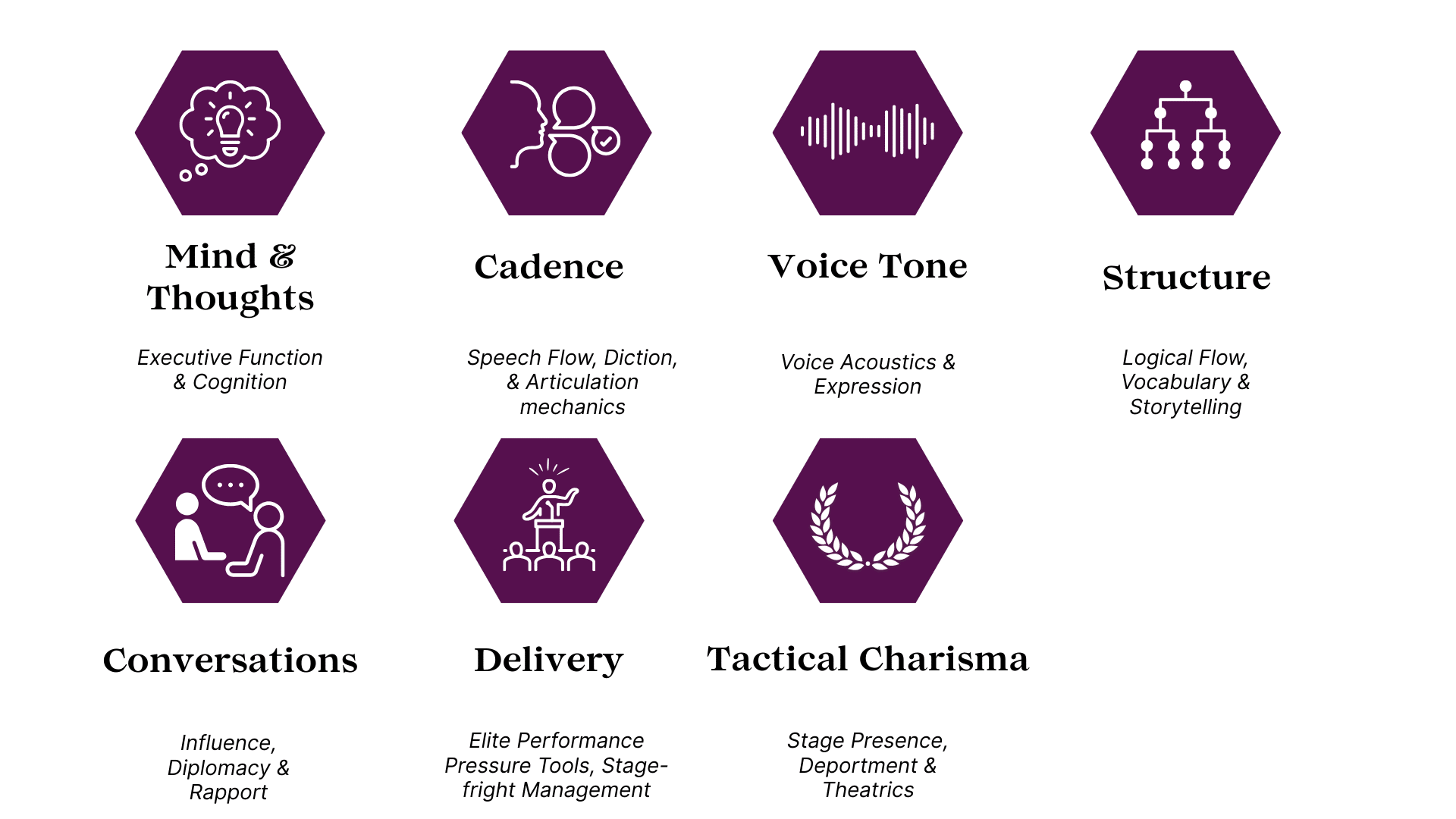
Since a viva is by word of mouth, the capacity to access oratory techniques when addressing the audience or responding to unexpected questions from the panel of assessors will help you to showcase your merits, proficiency, character and anticipated noteworthy contributions to the field.
Preparing to Present the Best CONTENT in the Viva Voce
Since we’ve agreed that a viva voce is a performance where you seek to transfer an honest, ethical and good impression to the panel or audience, let’s consider what to do about presenting the best content to your audience.
Content Tips for Doctoral Candidates
If you’re a PhD candidate awaiting the viva, often the first fear may be,
“How can I remember all aspects of my thesis?”,
or,
“What did I write again? Will I be able to recall it enough to give the answers my defence needs?”
When it comes to taking the viva you’ll benefit from speaker strategies that enable you to access clarity of thoughts under pressure [mind and thoughts] so that your responses briskly access memory recall, as well as good sequencing of your message [structure] when delivering it. Recall and message need to happen seamlessly and spontaneously so that you can access sufficient rationales, vocabulary and possibly even figurative language devices like storytelling, metaphors and analogy thus triggering the cognitive sophistication bias you desire.

No PhD candidate wants their defence to appear pithy, ill-formed or tangential in its written format, and performance pressures will mean you’ll aspire to avoid the same when speaking too.
The ideal outcome would be that you sound as erudite as you write, and thus cement a reputable impression throughout your defence using an exceptional turn of phrase and clear premises leading to a potent and unquestionable defence of the scholastic integrity behind your doctoral work.
To achieve cognitive clarity and present your key points precisely we recommend you use
- mental models to guide the flow of thoughts through clear logical structures, no matter the question type asked
- prepared definitions and findings, especially for new concepts your thesis develops, so that you can articulate your core contributions with less effort
- protocols for addressing challenging and unexpected questions with confident composure in the heat of the moment
Consider that what you say and how you say it in the viva voce becomes a data set for the panel to assess your knowledge, competence and skill by.
Content Tips for Medical Fellow Candidates
According to your specialty, your viva voce exam will likely have bespoke requirements. Usually, the format will be in the form of a semi-structured interview before a panel of interviewers or across a set of stations. Whether the discussion comprises behavioural or clinical decision-based questions, the ability to clarify your thoughts, demeanour and delivery will better situate you to demonstrate your legitimacy for acceptance as a fellow.
The panel aims to gain insight into who you are as a medical professional and whether you have the unique, desirable traits to add value and protect the legitimacy of the discipline.
In many cases, due to limits on positions, the highly competitive nature of entry can create a degree of mystery as to what the panel is seeking.
Your ability to access clear and cogent thoughts and present them confidently and in an influential manner in response to both the expected and unexpected questions, while establishing a memorable and noteworthy impressionm, may be what it takes to gain entry as a fellow.

The highly competitive nature of various specialities means it’s advisable to prepare how you respond to open behavioural questions in a manner that is both memorable and credible, the result of which will be determined by the logical clarity of your responses as much as your speaking style and delivery.
To achieve cognitive clarity and present your key points precisely we recommend you use
- mental models to guide the flow of thoughts through clear logical structures, no matter the question type asked
- tools to present responses to complex, ambiguous or unexpected questions are also recommended so that each response makes the most of your opportunities to share your insights in a composed manner
When you have the techniques to focus on content more effectively while under pressure, you free up processing space to pay attention to the social nuance of the conversation between the panel and interviewers which can enable you to focus more strategically on the performance and your delivery.

Talk with Confidence, Organise your Thoughts & Express yourself Clearly under Pressure.
[Executive, Emerging Leader or Industry figurehead focus available]
You can only learn to speak confidently with anyone anywhere if you have the tools to transform your speaking logic & habits. And your Executive Communication Profile Appointment shows you how. This science-based communication service helps you speak with clarity, charisma & confidence.
Discover The Communication Tactics that build Reputation & Authority among Industry Leaders, that you can use to fast-track your presence, charisma & eloquence.
Learn more about this personalised and strategic solution for your professional communication now.
[Executive, Emerging Leader or Industry figurehead focus available]
Incorporating Performance Tactics to Optimise your DELIVERY
We’ve established that a viva voce is a performance. Your audience, whether behind closed doors, at varying stations or sitting in the round, will in all cases be influenced by your delivery style. The way you present your responses must secure a strong impression that defends your thesis or showcases the desirable traits that make you well suited to being admitted as a medical fellow. Consider that what you say and how you say it in the viva voce becomes a data set for the panel or interviewers to assess your knowledge, competence and skill by. According to research, your personal communication style will showcase your expertise more effectively and form a solid impression if you demonstrate the following:
Logical Delivery Skills
Precise speakers are perceived as conscientious and competent. Avoid speaking in draft format by reducing filler sounds, phrase revisions, hesitations, unexpected pauses, tangents or lack of sequencing.
🚩 Be creative and discerning to be memorable
Using mental models and mnemonics can certainly assist your logical flow when speaking under pressure, but take care because if you're relying on the same format (such as the STAR method or the SOAR method) consider, most other candidates will use a similar approach so you may fail to be memorable! This is a vital consideration for highly competitive fellowship interviews, such as Cardiology, Plastic Surgery or Neurosurgery for example.
Captivating Storytelling
Learning to tell a real story (rather than a corporate style story) is a viable way to forge emotional connection and build trust in the legitimacy of your message. Stories are artistic, literary, emotionally fuelled. Stories can only be wewll told if delivered using performance tools. When rendered effectively, a captivating story results in a sensory and emotional experience for your listener creating neural coupling and increasing the likelihood that you’ll be remembered. You’ll benefit from training and rehearsal in how to tell captivating stories using performance tactics and this skill alone has the opportunity to set you apart from other candidates and make your message the most memorable.
💻Related Read: What the Top 3 Ted Talk Speakers did Differently
Speech Cadence
Cadence relates to the “regular rise and fall of sound, especially the human voice” (Cambridge Dictionary). Performance pressure tends to hijack our heart rate and blood pressure, affecting our internal clock and placing us at risk of rapid speaking or racing thoughts as the body strives to calibrate in the face of internal physical tempo changes and chemical shifts. Just as musicians learn to perform slower pieces, even when experiencing the jitters, speakers can also learn to compose and calibrate the rhythm and flow of their speech to serve their ideas with eloquent integrity. Interestingly, speakers that use cadence sound less hesitant, more assured of their ideas and tend to gain higher impressions of leadership potential, cognitive sophistication and charisma. If you’re concerned you have a high risk of mumbling, find yourself losing vocal clarity, speaking too fast or slow and using erratic pauses or many filler words, speech cadence training can assist you.
Cadence: regular rise and fall of sound, especially the human voice.
- Cambridge Dictionary
Confident Voice Tone
When orating, your voice is your instrument to mastery. Applying key voice skills will more than serve to position your messages, responses and insights successfully. Personalised voice training enables you to position your sound with clarity and consistency which triggers various positive biases that your message is more credible, your personality is more assertive, charismatic and that you're likely to be well disposed to leadership success. It may seem absurd that how you sound influences your career success, but we’re sure we’ve seen that working effectively in many instances for others. When it comes to the viva voce exam, goals around oratory eloquence that incorporate the ability to present an acoustic clear tone, to modulate the right intonation to render statements without hesitation and express balanced emotions with positive affect (avoiding monotone or excessive expression) will serve your delivery well. Additionally voice tone training will give you the tools to calibrate your speech system to create projectable, confidence and engaging tone, even when nervous.
Your Visual Impression
When we speak under pressure, it’s easy to focus on the internal thinking activities at the expense of recalling we are three dimensional organisms that present visual cues that our audience interprets. A good impression is formed by seamless integration between what we say and how we appear. As such, working on strategies around facial expressions, deportment, posture and gestures while speaking ensures you trigger positive bias cues that make the panel or interviewers perceive you in the best light.
Planning your attire strategically for the day is also recommended. We have prepared a resource to assist you with this. Although designed with workwear in mind, The Workwear White Paper provides some helpful ideas and research on how to increase your executive presence and credibility using attire that you might find useful to consider in light of your viva voce outfit.

Free Resource
The Workwear White Paper
Pick up The Ultimate, research-based Workwear White Paper for what to wear at work if you seek increased influence and executive presence.
Managing the Performance Pressure of the Viva Voce
Viva voce exams will elicit emotions that range from mildly anxious to petrified, no matter the specialisation (Stephenson, 2024).
Performance anxiety tends to manifest with two clusters of symptoms:
- body sensations (such as increased heart rate, shaking or other physical reactions) and,
- thought intrusions (such as racing thoughts, mental blanks, feelings of desperation or other mental responses).
With minimal opportunity to have completed an oral defence of this nature, it may be hard to establish your plausible reactions, especially for such an important rite of passage. It’s therefore beneficial to implement a strategic protocol to manage likely performance pressure.
To achieve mental and physical composure when faced with performance anxiety we recommend you use
- evidence-based protocols to manage speaking pressure. This is an area we provide detailed training in at Cadenza.
Stephenson et al (2024) found that even speakers who are normally calm in day to day interactions frequently face self-regulation barriers in oral exams. The only solution here is performance strategy. You might consider trialling beta blockers with consultation by your general practitioner, however the latest evidence into their efficacy suggests their impact on reducing intrusive thoughts and psychological pressures is questionable, even though they can be effective for blood pressure and heart rate management concerns, they may not give you all you need to compose and present eloquently. If this is something that perturbs you, consider reviewing the following resources on how to develop well-regulated, composed speaker eloquence, especially when orating or presenting:
Conclusion
Stephenson et al (2024) found that even speakers who are normally calm in day to day interactions frequently face self regulation barriers in oral exams. The only solution here is performance strategy. You might consider trialling beta blockers with consultation by your general practitioner, however the latest evidence into their efficacy suggests their impact on reducing intrusive thoughts and psychological pressures is questionable, even though they can be effective for blood pressure and heart rate management concerns, they may not give you all you need to compose and present eloquently. If this is something that perturbs you, consider reviewing the following resources on how to develop well-regulated, composed speaker eloquence, especially when orating or presenting:
💻Related Read: Public Speaking CPR
At Cadenza, we train public speaking for executives, leaders and experts so that the integrity of their thoughts, intentions and messages remain intact once in the boardroom, on camera or stage, using speech science principles and the CADENZA protocol to both set you and your listener at ease for the messages that matter
We have many resources and science-backed tactics that can assist you. If you’re searching for a public speaking coach to support your exciting upcoming speaking opportunities and want to learn more about how Cadenza can help, contact us today.
References
Cassidy, C. (2024, November 24). Voice from the past: how one university is countering AI with ancient examination techniques. The Guardian. https://www.theguardian.com/australia-news/2024/nov/25/back-to-the-futurum-how-one-university-is-countering-ai-with-ancient-examination-techniques
Medical Board of Australia. (2025, March 21). Specialist registration. https://www.medicalboard.gov.au/Registration/Types/Specialist-Registration.aspx
Riches-Suman, K. (2024). Supporting Doctoral Candidates through Completion and Final Examination. Encyclopedia, 4(2), 836-846. https://doi.org/10.3390/encyclopedia4020053
Stephenson, Z., et al. (2024). "Student experiences of the ‘closed-door’ PhD and doctorate level viva voce: a systematic review of the literature." Assessment & Evaluation in Higher Education 49(5): 601-615.

About the Author
Dr Sarah Lobegeiger de Rodriguez
PhD (Opera), MMus, MSpPath, Cert. Practicing Speech Pathologist
Dr Sarah is a Keynote Speaker, Executive Speaking Coach, Certified Practicing Speech Pathologist and Opera Singer who likes to play with words, sounds, and your impact.
Her academic background is in Music Performance, Communication Science and Speech & Language Pathology. She assists executive communication clients all over the world as a communication consultant with strong expertise in CEO, Founder and Entrepreneur communication strategies.

Did you enjoy this post? Make sure to subscribe to our YouTube channel to get more content to increase your communication skills!