
EXECUTIVE PRESENCE
How to Select an Executive Public Speaking Coach: Gain Exemplary Oratory Skills
The complete guide to choosing speech training that gets you outcomes for discerning executives, experts and industry leaders.

Key Benefits of Selecting an Effective Public Speaking Coach
- A skilful public speaking coach can provide you with concrete strategies that intersect with your desired stage presentation skills.
- Improvements in public speaking skills are more likely if your speech coach commences with a personalised assessment of your oratory skills to create a clear baseline to track growth against.
- Be discerning when choosing a speech trainer to ensure your program incorporates practical, tested methods to improve your on-stage, media or camera speech delivery.
- If most public figures, industry leaders, and even famous historical personalities extensively worked on their presentation skills, why shouldn’t you?
- Public Speaking prowess is the crown jewel of communication ability.
- Oratory skills are not simply limited to addressing stage fright. The performance context requires a multi-dimensional skill set to serve the audience and captivate hearts and minds.
Content
- How to know if you need to improve your oratory skills and enlist a public speaking consultant?
- Should you choose a public speaking program or focus on career communication instead?
- How to choose a reputable speech coach
- Key capabilities public speaking training may help you with
- Can you improve your public speaking skills by working 1-1 or is group public speaking program more effective?
- Are you more suited to group or individual sessions?
- How to know if you need a confidential service for your public speaking training?
- Is Toastmasters enough to improve your public speaking skills?
- Are online sessions as effective as in person sessions?
- Key questions to ask when choosing a public speaking trainer.
How to know if you need to improve your oratory skills and enlist a public speaking consultant?
Great public speakers make it look effortless, and it’s rare to see the behind-the-scenes work in private practice, coaching and skill development that got them there. Anyone can work on their oratory skills, and like general health and fitness, it can be an ongoing or immediate goal, depending on your situation.
If you have an upcoming keynote or are stepping into a new role, you’ve likely considered working on your public speaking skills to get new coping strategies to manage higher-pressure expectations. Public speaking training may be a suitable option if you need to perform at a high level in a specific environment that involves, by criteria, an audience.
Oratory: the act of giving skilful and effective speeches in public.
- Cambridge Dictionary
Do you need to give skilful and effective speeches in public? If the answer is yes, a public speaking program would be the right fit.
Many people choose public speaking programs to address concerns about coping with speaking stress without needing to give speeches or pitches, which accounts for why many public speaking training attempts fail. Stage training differs drastically from career conversations. You'll need to use your voice, posture, storytelling, and demeanour differently on stage, and stage fright has a different markup from regular speaking stress.
Tools for the stage, camera or podium are drastically different to those for the boardroom.
All professionals can experience communication stress when interacting professionally. Although it may feel like stage fright, you'll need a program suited to the precise barriers to get the anticipated outcome.
5 Tips to Help you Choose the Best Communication Coach
Should you choose a public speaking program or focus on career communication instead?
We suggest deciding whether your goals relate to:
- Career communication or,
- Public Speaking & Oratory Skills
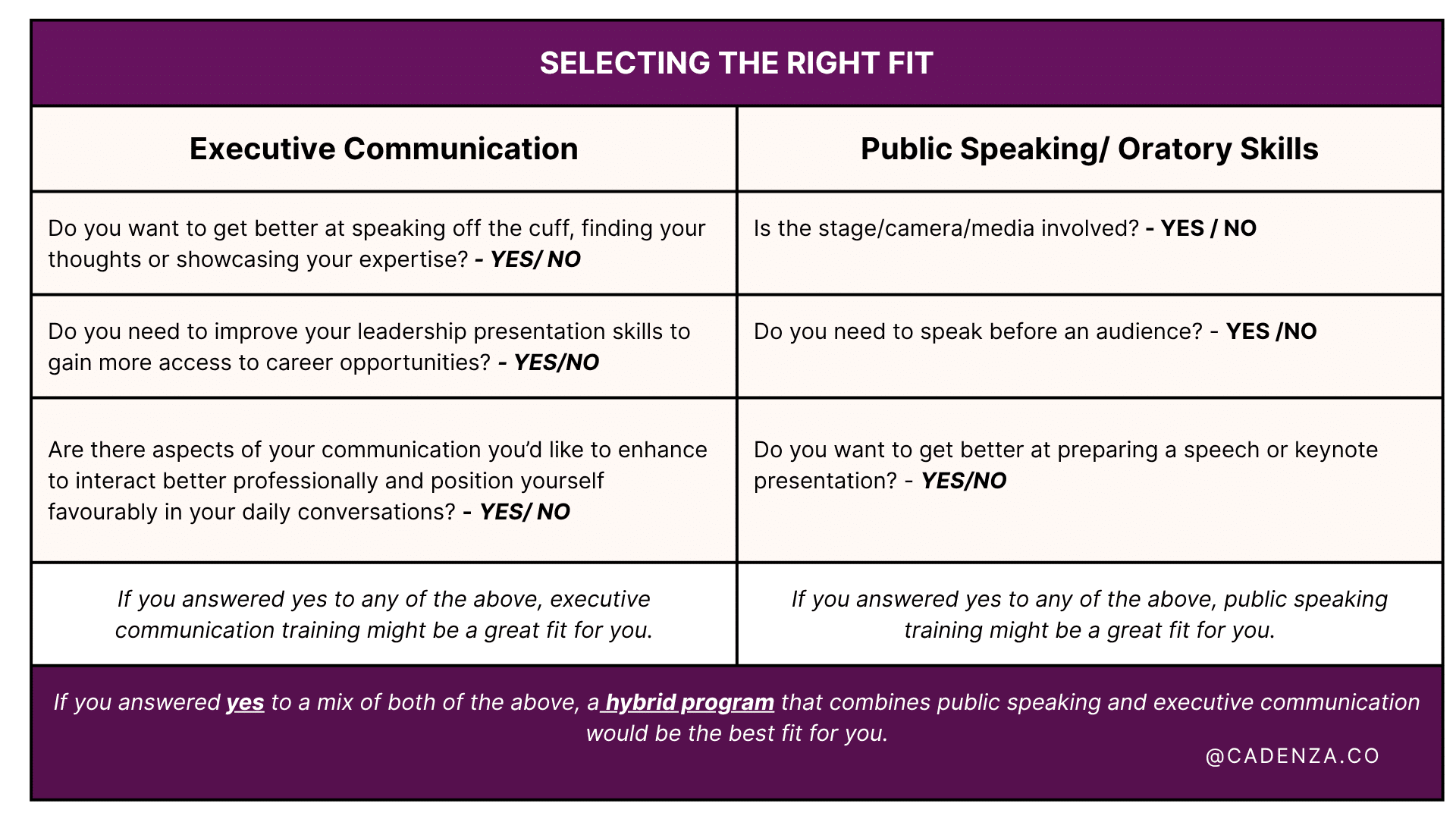
The following questions can assist you to weigh up what you need.
SELECTING THE RIGHT FIT
Executive Communication
Public Speaking & Oratory Skills
- Do you want to get better at speaking off the cuff, finding your thoughts or showcasing your expertise?- YES/ NO
- Is the stage/camera/media/podium involved?- YES/ NO
- Do you need to improve your leadership presentation skills to gain more access to career opportunities?- YES/ NO
- Do you need to speak before an audience?- YES/ NO
- Are there aspects of your communication you’d like to enhance to interact better professionally and position yourself favourably in your daily conversations?- YES/ NO
- Do you want to get better at preparing a speech or keynote presentation? - YES/ NO
If you answer yes to any of the above, executive communication training might be a great fit for you.
If you answer yes to any of the above, public speaking training might be a great fit for you.
If you answered yes to a mix of both of the above, a hybrid program that combines public speaking and executive communication would be the best fit for you.
public speaking coach
Figure 1 Choosing the right program is the only way to get public speaking outcomes you're happy with.
Although public speaking training can be an element of executive communication consulting, a pure public speaking pathway is advisable only if you have goals directly tied to stage, camera or podium-based activities. This way, you can narrow down a specialist consultant to help you with a precise brief, and you’ll have more chances of gaining tested methods for audience engagement, stage fright, voice modulation, theatrics, stage presence, deportment and more. These techniques can vary significantly from day-to-day career interactions.
- Common Career communication goals: Speaking more effectively in meetings, discussions with team and stakeholders, job interview tactics, assertive communication, emotional intelligence, strategies for self-regulating under pressure, and leadership presence.
- Common Oratory goals: Any brief that focuses on achieving improved stage, camera or media presence, managing nerves, increasing charisma, emoting with your facial expressions and gestures, scripting planned stories, and modulating your voice tone when delivering your message before a gathered audience.
How to choose a reputable speech coach
As artistic and mysterious as it seems to the audience, stage training is a regimented, systematic and robust discipline with a deep history, thorough pedagogy and these days profound research validation. Stage performance counts on spectacle. The goal when performing is to serve the audience which lends itself to the impression of effortlessness.
But elite performers are made, not born.
Spectacle: one of the six elements of drama as defined by Aristotle involving the production of spectacular effects.
The craft of performance presence on stage can be distilled into a behind the scenes and on the scenes process of beguiling the audience with a captivating and mesmerising presentation.
This is a high ask, so who can help you do that best?
Here are a few considerations to help you choose a reputable speech coach.
Credentials
The coaching space is noisy and impression seeking. For this reason, evaluate whether coaches you’re considering to work with have the credentials to train you. This will help you narrow your options and ideally assist you to find the ikigai fit you’re looking for!
Seek out consultants who are capable of both
- Delivering a captivating and influential oratory performance themselves
- Knowing how to teach others to do the same using proven methods
Ideally, you’ll want a polymath because the skill set for effective public speaking is multi-dimensional.
Polymath: a person who knows a lot about many different subjects.
They’ll need to be able to train you in an array of dimensions that the stage calls for from you. We refer to this best with the 7 Cadenza Communication Dimensions.
7 CADENZA® Communication Domains

CADENZA COMMUNICATION DOMAINS (1)
Figure 1-The Cadenza Communication Dimensions are a useful way to consider the varied skill set a solid public speaking curriculum will need to cover.
Here are a few questions you can ask to establish if the individual you’re considering working with has the skill set needed to help you.
Is the public speaking coach a qualified voice trainer?
The voice is a complex muscle that can be harmed if poorly handled. To get good voice tone outcomes consider selecting a speech coach who has advanced qualifications in speech and language pathology, vocal pedagogy, diction coach or acting as these individuals will have a clearer understanding of how the voice works.
Is the public speaking coach a qualified voice trainer? Is the public speaking coach qualified to provide feedback on your message structuring?
It’s not enough to check your speech in chat gpt (don’t). Hire a coach who can provide you with skilful understanding of spoken prose. Ideally they should write well themselves. To convey effective sentiment your presentations will need someone skilled in rhetoric, consider hiring a speech coach who has advanced qualifications or skill in literature, creative writing, copywriting, advertising or the humanities (philosophy, theology, history, art criticism) as these individuals will usually have the capacity to put your speech through deep exegesis and provide you with guidance on how to adapt and better it coupled with a rich vocabulary.
Exegesis: critical explanation or interpretation of a text.
- Oxford Dictionary
Is the public speaking coach qualified in prose-based performance themselves?
Skill on stage, before the podium and on camera differs drastically from day to day speaking confidence. To become an effective performer select a speech coach who has advanced qualifications in theatre as these individuals are more likely to both understand stagecraft and appraise what your delivery needs. Hire a performing artist, ideally from genres that use the voice (stage or film actors, opera singers, musical theatre performers, cabaret, stage directors, these individuals understand how to move the body and voice in space while using text more than instrumentalists).
🚩 Be discerning:
There are many public speaking trainers out there who indicate credentials from reputable performing arts institutions (acting schools and more) who have only obtained a quick certificate course who will then charge you more than they paid to get the basic certification. Choose trainers who trained as performers professionally at an academic level, not via a short course.
Experience
Research how much experience the consultant has had training public speakers.
Years of Work
How long has the public speaking coach worked in communication, performance and consulting? Their degree of experience will likely predict how effective your outcomes will be.
Type of clients
Public speaking styles and needs can vary drastically depending on your industry, role and objectives. Has the public speaking coach worked with similar clients? Do they have experience with your industry or goals? For example, suppose you're a medical professional creating content to launch your new product on the market. In that case, you'll want to find a public speaking coach who can assist you with activities related to your product launch, founder presentations, product Q&A sessions, presenting yourself and the product for affiliate marketing content and more.
Proof of Skill
Passionate trainers typically demonstrate their skill in the subject area since the topic animates them. Does the public speaking coach have a record of the material they are presenting? How does their public profile appear to you? Do you like their delivery style? Are they eloquent, composed, charismatic and authoritative on camera? Do they seem at ease in their content?
If the consultant is well regarded, you will likely find evidence that they have partnered with larger organisations, which can add further insight into their authority in the space. Not all public speaking coaches will push for referrals, testimonials and reviews from their private paying clients, especially if they deal with household names and strive to protect their clients' confidentiality.
Key capabilities public speaking training may help you with.
Elite public speaking coaches can assist you with the following aspects:
- Managing stage fright
- Strategies to find the right speaking speed (see our article on Cadence)
- How to warm up for presentations
- Improving thought clarity and logic if you’re experiencing mental blanks or freezing up on stage.
- Securing vocal presence when presenting: Voice projection, clarity and reducing monotone, how to use your voice like an actor or broadcaster
- Calibrating your breathing so you don’t gasp, run out of breath or lose respiratory control when presenting
- Charismatic stage presence tactics
- Deportment, how to carry yourself on stage
- Chironomia (hand gesture tactics)
- Rhetorical devices for the stage and speeches
- Eye contact strategies to use with your audience or the camera
- How to use a teleprompter
- Balancing appropriate body language for large and small auditoriums
- Responding to difficult questions from a podium, in a press meeting or tribunal
- How to deliver a prepared pitch more effectively to investors or stakeholders in a way that encourages buy-in.
- Speaking confidently on stage if English is your second language (choose a culturally sensitive service for this)
- How to rehearse more effectively for your presentations
- Content creation techniques and delivery styles recommended for founders or industry leaders
- How to use a hook, openers and closers in your presentations
- Varied Storytelling tactics and which are best for your profile and audience.
- How to prepare a public speaker biography
- Work on your Ted Talk
- Training in delivering significant corporate keynote speeches (e.g. Vision presentations, AGM meetings, presenting in committee meetings and more)
Can you improve your public speaking skills by working 1-1 or is a group public speaking program more effective?
You’re probably wondering how you can work on your public speaking skills without an audience? If you think that public speaking training can only be effective in a group setting, keep reading!
Your public speaking outcomes are achieved in front of an audience, but the steps to appear charismatic, eloquent and polished before the crowd need careful instruction, practice and training offstage. Just as an olympic sprinter does not need a stadium full of people to train, public speakers do not need to be trained in a crowd or group workshop to get results.
Most performers (musicians, singers, actors) work with a teacher individually to improve their craft. Lessons are conducted individually to enable efficient skill building. The same should apply for public speaking.
Selecting the Right Delivery

Are you more suited to group or individual sessions?
Individual sessions: are the most efficient way to address the key skills needed to master charismatic delivery onstage as a public speaker as they better enable you to address the voice tone training, public speaking anxiety management protocols, speech cadence, language and structure factors your presentations may need.
We made an entire video about the most practical, systematic approach to signal charisma through concrete presentation training.
💻Related Read: The Expert Guide to Charismatic Executive Presentations
Group sessions: are a good fit if you have already worked in detail on your public speaking skills and want to get more on-stage practice.
How to know if you need a confidential service for your public speaking training
If you're an industry leader or intend to be a household name, don't compromise your public speaking intel in a group setting. Handling your unique value offer, IP and approach with care and confidentiality is essential. Joining a popular group-based program lends itself to creating a cookie-cutter presentation. Your biggest asset as a speaker or performer is the unique approach you build to deliver your authentic presence on stage. Soloist opera singers were traditionally cautioned to never sing in choirs, so they train their voices to blend instead of stand out. Violin virtuosos don’t play with the orchestra. Actors train diction alone with one accent coach. Elite speakers should consider the same. Enrolling in the public speaking program that everyone is doing sets you at risk of doing it like everyone else, thus losing the unique value you can bring to your audience, personal brand and industry.
Furthermore, suppose you're in public office or working on speaking skills for matters of strictest confidence (an AGM meeting, a Speech for a Royal Commission or Crisis communications). In that case, you will have no way of practising your material and delivery tactfully and wholeheartedly in a group model.
Is Toastmasters enough to improve your public speaking skills?
Joining Toastmasters is an excellent idea if you don't meet the criteria needed to protect your anonymity when working on oratory skills. There are mixed reviews around how helpful Toastmasters is to acquiring new skills with public speaking (building voice tone nuance, securing effective speech cadence and more); however, attending your local Toastmasters events will allow you to practice the skills you've been working on the with your dedicated public speaking coach before an audience. Just as a marathon trainer may do many runs solo to build skills, they will do a few local group runs to build community spirit and socialise with other runners. Toastmasters groups are similar, but only for your public speaking participation.
Are online sessions as effective as in person sessions?
You may have found a public speaking coach you're keen to work with who doesn't live in your city. Can online sessions help you reach your goals?
Online communication is an integral part of our world these days. It has a role in your public speaking outcomes, especially if you are working on key goals around camera presence for video or media appearances.
Successful public speaking training incorporates a varied skill set. If you select this method, a public speaking coach with extensive experience in online training can cover all of the skills you need for stage, podium or camera. Many musicians and performers consult with their teachers these days to access the highest quality instructors, and research supports the effectiveness of online tuition in the development of performance skills (Ouyang, 2023, and in some cases, the integration of digital technology in the thespian space saw an increase in "efficiency and interactivity" (Schiavio et al. 2024).
Thespian: (adjective) relating to drama and the theatre, (noun) an actor.
Considerable research into online public speaking training versus face-to-face has established that digital teaching methods are comparable with both approaches, leading to a positive reports from participants as well as noteworthy outcomes regarding anxiety reduction and increased presenting competence (Linardopoulous, 2010; Broekelman-Post et al., 2019; Buehler et al., 2023).
Although most consultants may prefer face-to-face or online, selecting the program option that fits your busy schedule with the coach you resonate with is essential. If that means working with someone on the other side of the world, it will be an inspiring experience for you, provided you're clear on your goals and how the program helps you achieve them.
💻Related Read: The 5 Canons of Rhetoric: How Powerful Ancient Romans Spoke
Key questions to ask when choosing a public speaking trainer
We’ve prepared a list of some important questions you might like to ask
- How is a typical training session structured?
- Does your program include detailed voice, stage and theatrical training needed for public speaking?
- Do you assist with storytelling, reporting on data and strategies for slides?
- Will your program provide strategies and solutions to help me manage stage fright better?
- Is your program built on proven research-based methods or your opinion and experience?
- What kind of feedback will I have access to in my sessions?
- What practice and preparation between sessions do you recommend to strengthen outcomes in my program?
- Do you provide additional feedback outside of sessions (document reviews, video reviews and more), and is this included in the program or an additional billable?
- How can I measure my progress when working on my public speaking?
- Does your program incorporate AI? If so, how are you using it, and what is your policy on AI?
- What kind of results do your clients get from your program and training?
Conclusion
The public speaking training market is only set to grow as AI and digital transforms the world. A large-scale Mckinsey study of 18,000 people in 15 countries uncovered 56 foundational skills deemed desirable with a high likelihood of yielding “higher likelihood of employment, higher incomes, and job satisfaction” and singled out public speaking and story telling skills as key elements of communication proficiency.
It’s unanimous that public speaking skills and the ability to show up on stage with charismatic self-assurance yield high personal satisfaction and significant career and reputation advantages.
At Cadenza, we train public speaking for executives, leaders and experts so that the integrity of their thoughts, intentions and messages remain intact once in the boardroom, on camera or stage, using speech science principles and the CADENZA protocol to both set you and your listener at ease for the messages that matter
We have many resources and science-backed tactics that can assist you. If you’re searching for a public speaking coach to support your exciting upcoming speaking opportunities and want to learn more about how Cadenza can help, contact us today.
References
Broeckelman-Post, M., Hawkins, K. E., Arciero, A. R., & Malterud, A. S. (2019). Online versus Face-to-Face Public Speaking Outcomes: A Comprehensive Assessment.
Basic Communication Course Annual, 31, Article 10.
Bühler, J., Schwind, C., Burr, D., & Jirak, D. (2023). Virtual reality public speaking training: Effectiveness and user experience.
Frontiers in Virtual Reality, 4, 1242544. https://doi.org/10.3389/frvir.2023.1242544
Linardopoulos, N. (2010). Teaching and learning public speaking online.
MERLOT Journal of Online Learning and Teaching, 6(1), 198–210. https://jolt.merlot.org/vol6no1/linardopoulos_0310.pdf
McKinsey & Company. (2021, June 25). Defining the skills citizens will need in the future world of work. https://www.mckinsey.com/industries/public-sector/our-insights/defining-the-skills-citizens-will-need-in-the-future-world-of-work
Ouyang M. (2023). Employing Mobile Learning in Music Education. Education and information technologies, 28(5), 5241–5257. https://doi.org/10.1007/s10639-022-11353-5
Schiavio, A., Biasutti, M., & Antonini Philippe, R. (2024). Evaluating the effectiveness of using digital technologies in music education. Journal of Educational Technology Development and Exchange, 17(1), 283–299.

About the Author
Dr Sarah Lobegeiger de Rodriguez is a Keynote Speaker, Executive Speaking Coach, Certified Practicing Speech Pathologist and Opera Singer who likes to play with words, sounds, and your impact.
Her academic background is in Music Performance, Communication Science and Speech & Language Pathology. She assists executive communication clients all over the world as a communication consultant with strong expertise in CEO, Founder and Entrepreneur communication strategies.
Connect with Sarah on LinkedIn.

Did you enjoy this post? Make sure to subscribe to our YouTube channel to get more content to increase your communication skills!